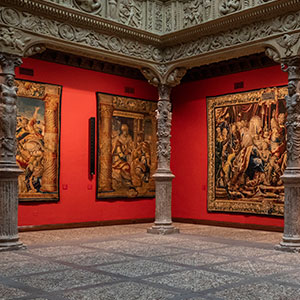
Ibercaja Patio de la Infanta, located in the heart of Zaragoza´s City centre, houses the Patio de la Infanta monument. This monument was built in the mid-16th century, in its beginnings was part of the palace that the banker and merchant Gabriel Zaporta owned in Calle San Jorge. It has the usual structure of Aragonese Renaissance courtyards, among which it stands out for its novel decoration. Love and astrology, art and esotericism, politics and history, make this place a fascinating universe.
Next to the exhibition hall, where some of the most important exhibitions in the city are held, and the various rooms available for holding conferences and activities, make this space a perfect place for the development of all kinds of cultural and social events.
Next to the exhibition hall, where some of the most important exhibitions in the city are held, and the various rooms available for holding conferences and activities, make this space a perfect place for the development of all kinds of cultural and social events.
The monument
The organ of the Patio de la Infanta was built in 1692 by the master organ builder José de Sesma, as stated in an inscription found on the windchest: Joseph de Sesma me fecit en Çaragoça año 1692. He built it for the parish church of San Pedro Apóstol in Saviñán, in the diocese of Tarazona. The organ cost 470 pounds and the case 43. With its installation, in 1693, the total rose to 1,000 pounds.
This Aragonese Plateresque organ, with a classical and austere structure, measures 4.470 meters high, 2.588 wide and 0.860 deep. It consists of a keyboard of forty-two notes, seventeen divided stops and five hundred and seventy-three pipes installed in a case made by the master carpenter Juan de la Sala.
It is made of Scots pine wood, except for the solid block of the Batalla (Battle) which is made of cherry wood, and the slider ends, the stop-action lever and the keys, which are made of walnut wood. The jambs, imposts, architraves and the fields of the rustication are carved, as are the corner pieces of the towers, the intermediate openings, and the four volutes. A set of great ornamental beauty. In the central tower one can see Aeolus, the god of the wind. The coat of arms topping this central tower is the coat of arms of Saviñán, a tree that could be an acacia.
The organ of Saviñán was sold in 1979 to an antique dealer from Zaragoza as “remains of an organ”. Ibercaja bought them in 1990 and entrusted its restoration to another master organ builder, José María Arrizabalaga, who rebuilt it piece by piece. He invested four thousand hours of work.
The front of the organ is made up of 33 tin pipes plus four decorative pipes. The organ had been stripped of its metal pipes; but fortunately, José de Sesma left the patterns of the pipe carvings marked with a compass around the wind holes, and the reconstruction could be carried out using reliable references.
The original 42 notes of the keyboard were replaced by 56 in 1904, but these were not preserved either. For the restoration, a replica was built of the keyboard of another organ also made by José de Sesma, the one in the parish church of the Assumption of Our Lady in the Zaragoza municipality of Acered, located 30 kilometers from Saviñán.
On October 15, 1992, on the third centenary of its construction, the organ was installed in the Patio de la Infanta. That same day the Joseph de Sesma Organ Series was held for the first time.
An exceptional musician, José Luis González Uriol, offered a concert on October 28, and the sound of the organ filled the patio—once considered lost forever—with meaning and beauty. That same year, González Uriol was appointed Titular Organist of the Historic Joseph de Sesma Organ of the Patio de la Infanta. His career and prestige have made possible many memorable concerts. The world’s best early-music performers have played the organ of the Patio de la Infanta.
The beauty of the patio, with its revealing emblems, protects this treasure of Aragonese Baroque.
The tapestry collection of Fundacion Ibercaja
Tapestry art of the XVI and XVII centuries
The Esther and Ahasuerus Series
The Vengeance of the Jews The Banquet of Ahasuerus Haman's rebuke to Mordecai
The Dido and Aenas Series
The Banquet of Dido and Aeneas The Sacrifice of the steer Dido's sacrifice
The Crucifixion and Resurrection
The birth, circumcision and infancy of Isaac
Tapestry art of the XVI and XVII centuries
The Esther and Ahasuerus Series
The Vengeance of the Jews The Banquet of Ahasuerus Haman's rebuke to Mordecai
The Dido and Aenas Series
The Banquet of Dido and Aeneas The Sacrifice of the steer Dido's sacrifice
The Crucifixion and Resurrection
The birth, circumcision and infancy of Isaac
Welcome to Patio of la Infanta
- Lorem ipsum dolor sit amet
- Pellentesque ornare justo