Francisco de Goya y Lucientes (1746–1828) is one of the most influential figures in the history of Western art. A court painter and radical artist, a chronicler of his time and a forerunner of modernity, his work reflects the light and shade of the human condition with unprecedented intensity.
Born in Fuendetodos, a small village in Zaragoza, Goya maintained a deep connection with Aragon throughout his life, the region where he developed both artistically and personally before embarking on a career that would take him to the court of Madrid and bring him international recognition.
The early years: Zaragoza as an artistic starting point
As a child, Goya moved to Zaragoza, a city that would have a decisive influence on his artistic development. There, he began his apprenticeship in the studio of the painter José Luzán, where he was introduced to the academic style and Baroque painting traditions. In Zaragoza, he also discovered the value of drawing as the foundation of artistic creation, a discipline he would never abandon.
During these early years, Goya frequented the city’s artistic and cultural circles and undertook his first significant commissions, particularly in the field of mural painting.
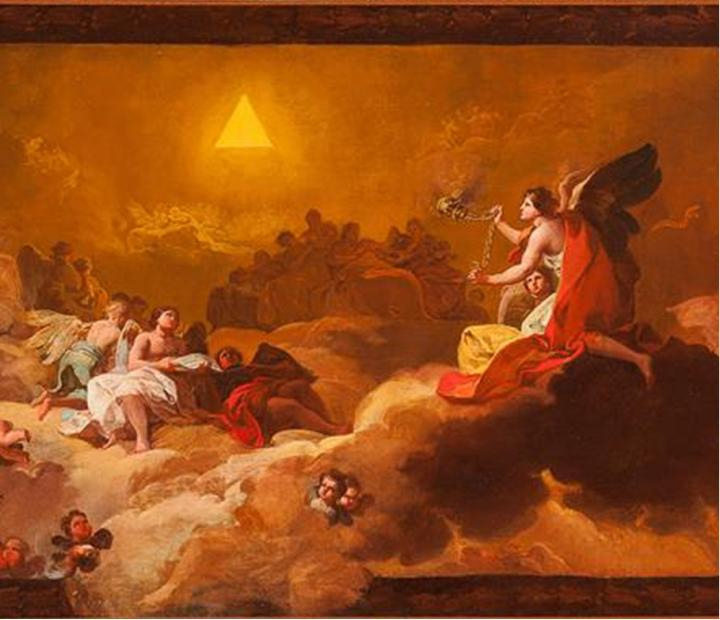
Throughout his life, Francisco de Goya y Lucientes maintained a deep and enduring connection with Zaragoza, the city where he trained as an artist and took his first decisive steps. Among the most significant sites associated with this relationship is the Basilica del Pilar, not only as a spiritual and urban symbol of the city, but also as one of the key settings in the painter’s early career.
Goya worked at the Basilica del Pilar on several occasions during his youth. In 1772, he painted the frescoes on the vault of the Coreto, dedicated to the Adoration of the Name of God. Although this work belongs to an early period, it already displays traits that foreshadow his genius: dynamic compositions, figures full of movement and an expressiveness that was unconventional for religious painting of the time. In contrast to the dominant rigid academic style, Goya introduces an almost theatrical energy, with a bold use of colour and light.
Years later, in 1780, he returned to El Pilar to paint the dome of the Regina Martyrum. By then, Goya had matured artistically and his pictorial language was more robust and personal. In this work, dedicated to the Virgin as Queen of Martyrs, the drama intensifies: the martyrs’ bodies are depicted in daring foreshortened poses, with powerful anatomy and an emotional intensity that reinforces the tragic nature of their sacrifice. The painting seeks not only to inspire devotion, but also to make a visual and human impact.
From Zaragoza to the court
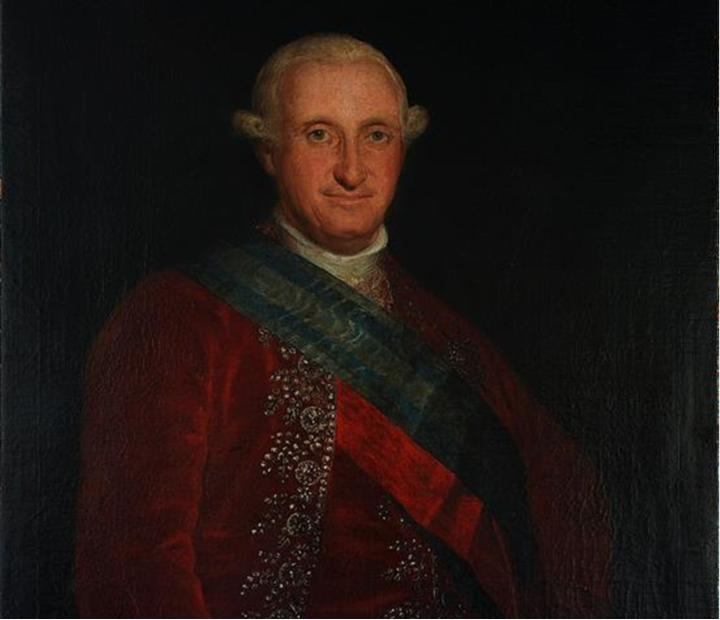
After completing his training and undertaking a formative trip to Italy, Goya settled in Madrid, where he embarked on a successful career in the service of the Royal Tapestry Factory and, later, the Royal Household.
He was eventually appointed court painter, portraying the royal family and high society with a gaze as penetrating as it was honest. Far from idealising his subjects, Goya was able to capture their psychology and the spirit of their time, transforming portraiture into an exercise in truth.
Francisco de Goya’s early years at court marked a decisive turning point in his artistic career. After training in Zaragoza and completing his apprenticeship in Italy, Goya moved to Madrid with the ambition of making his mark in the demanding courtly environment, where royal favour and networks of power were crucial to a painter’s success.
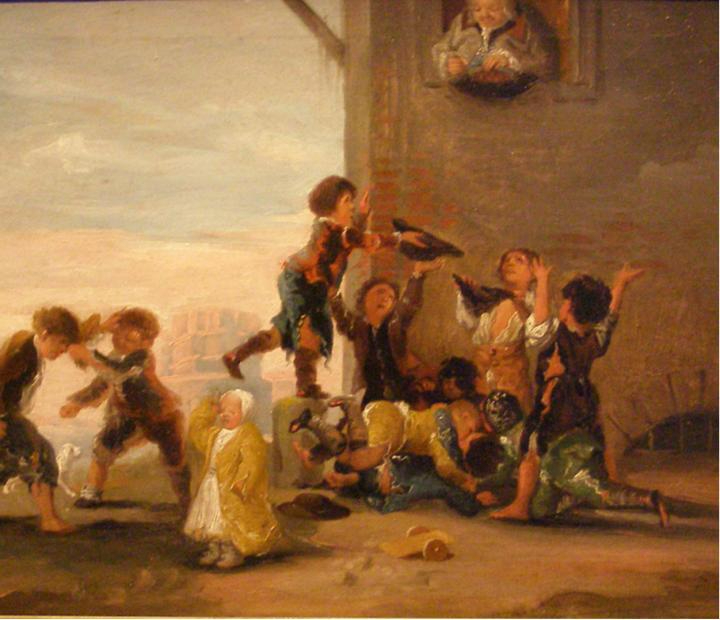
His entry into court life was a gradual process. In 1775, he began working for the Royal Tapestry Factory of Santa Bárbara, producing cartoons intended to decorate the royal palaces of El Escorial and El Pardo. These works, with their cheerful, genre-based themes—scenes of games, folk festivals and everyday life—allowed him to demonstrate a great narrative skill, a mastery of luminous colour and a perspective closely attuned to the common people, traits that were uncommon in the official art of the time.
Thanks to this steady work, Goya gradually gained prestige and patronage within the court. In 1780, he was admitted to the Royal Academy of Fine Arts of San Fernando, a key institutional recognition that consolidated his position in Madrid. Shortly afterwards, he began to receive commissions as a portrait painter, a genre in which he quickly distinguished himself through his ability to capture not only the appearance but also the psychological character of his subjects.
During these early years at court, Goya developed an increasingly personal style. Although he had to adapt to the conventions of official portraiture, he introduced an unprecedented naturalism and a certain critical distance from the nobility he depicted. His portraits convey elegance and power, but also humanity, and even fragility, foreshadowing the lucid and penetrating gaze that would characterise his mature work.
Thus, Goya’s early years at court were not merely a social and professional rise, but also the laboratory in which the artist forged his own artistic language. From that privileged environment, Goya began to observe Spanish society with a depth that, over time, would evolve into one of the most complex and modern visions in Western art.
Social criticism as an artistic perspective
Social criticism is one of the central themes of Francisco de Goya’s work, and defines his most modern and radical artistic vision. Throughout his career, the painter developed a profoundly lucid view of the Spanish society of his time, characterised by inequality, superstition, violence and the abuse of power. Far from merely depicting reality, Goya interpreted and questioned it with unprecedented freedom.
This critical attitude is particularly evident in his prints, in series such as *Los Caprichos* (1799). In these prints, Goya uses satire and symbolism to denounce the vices of society: ignorance, corruption amongst the clergy, marriages of convenience, prostitution and the oppression of women. The famous print *The Sleep of Reason Produces Monsters* encapsulates his thinking: when reason falls asleep, fanaticism and barbarism emerge.
Goya’s social criticism intensified with the historical events he witnessed first-hand. During the War of Independence, his perspective became harsher and more direct. In *The Disasters of War* (1810–1815), he abandoned any heroic idealisation to depict the anonymous suffering of the victims, the brutality of both sides and the dehumanisation caused by violence. Here, his condemnation is no longer ironic, but profoundly tragic and universal.
Goya also applied this critical perspective to his painting. Even in his official portraits of the nobility and the royal family, he introduced a subtle tension between appearance and truth. In works such as *The Family of Charles IV* (1800), power is depicted without idealising artifice, leaving the viewer faced with an unsettling and revealing portrayal.
Goya’s artistic vision, grounded in observation, reason and personal experience, foreshadows modern sensibilities. His social critique offers neither solutions nor consolation; it merely reveals, with relentless honesty, the contradictions of human beings and their times. For this reason, Goya was not merely a witness to his era, but an artist who used art as an instrument of conscience and reflection, projecting his vision beyond the boundaries of 18th-century Spain.